
How to Avoid a Declined Payout During 2 Year Contestability Period
Free Life Insurance Comparison
Compare Quotes From Top Companies and Save
 Secured with SHA-256 Encryption
Kristen Gryglik
Licensed Insurance Agent
Kristen is a licensed insurance agent working in the greater Boston area. She has over 20 years of experience counseling individuals and businesses on which insurance policies best fit their needs and budgets. She knows everyone has their own unique needs and circumstances, and she is passionate about counseling others on which policy is right for them. Licensed in Massachusetts, New Hampshire,...
Licensed Insurance Agent
UPDATED: Dec 4, 2023
It’s all about you. We want to help you make the right coverage choices.
Advertiser Disclosure: We strive to help you make confident insurance decisions. Comparison shopping should be easy. We are not affiliated with any one insurance provider and cannot guarantee quotes from any single provider.
Our insurance industry partnerships don’t influence our content. Our opinions are our own. To compare quotes from many different insurance companies please enter your ZIP code on this page to use the free quote tool. The more quotes you compare, the more chances to save.
Editorial Guidelines: We are a free online resource for anyone interested in learning more about insurance. Our goal is to be an objective, third-party resource for everything insurance related. We update our site regularly, and all content is reviewed by insurance experts.
UPDATED: Dec 4, 2023
It’s all about you. We want to help you make the right coverage choices.
Advertiser Disclosure: We strive to help you make confident insurance decisions. Comparison shopping should be easy. We are not affiliated with any one insurance provider and cannot guarantee quotes from any single provider.
Our insurance industry partnerships don’t influence our content. Our opinions are our own. To compare quotes from many different insurance companies please enter your ZIP code on this page to use the free quote tool. The more quotes you compare, the more chances to save.
On This Page
If you’re the insured on a life insurance policy and die within the first two years of the issue date, the insurance company may have the right to contest or even deny your claim.
Not to worry…
Most of the time, what this means is they’ll investigate to find out if you made any “misrepresentations” on your policy application.
In other words, did you lie?
If the misrepresentation is “material”, meaning that had they known about it at the time of underwriting, they may not have offered you insurance, then in some cases, they can deny the claim.
In this article, we’ll walk you through the exact steps to help you avoid that scenario, and point you in the direction of companies you can trust to pay out your life insurance money.
How The 2-Year Contestability Clause Works
You may have found this article because a life insurance company is delaying, denying or contesting your claim due to a death inside of the two year contestability period.
If so, we can help!
Example of Material Misrepresentation

I use Google Analytics on my website, and can see that lots of people find my article on life insurance for those who smoke by searching “What happens if I don’t disclose pot use on life insurance application?”
That’s easy.
Other than committing insurance fraud, if you die within two years and the insurance company finds out you lied on the app, they have grounds to contest the claim (not pay the claim).
During the carrier’s investigation, they’ll look for things you concealed from them on the application.
Common facts people hide the truth about are:
- their medical history,
- their occupation,
- smoking
- drug or alcohol use/abuse
- and hazardous activities such as SCUBA diving or rock climbing
A carrier’s investigation may include requests for medical records, an autopsy report, and a statement from the agent. They may also question the deceased’s friends and family members.
Say you went on vacation to Mexico and had a heart attack and had bypass surgery. When you returned to the U.S., you purchased a U.S. life insurance policy, and did not disclose your medical history in Mexico.
If the carrier insures you, and you die within the first two years, they could find out you withheld information from them and deny the claim.
That means your beneficiary(ies) don’t get the death benefit.
However…. “Material Misrepresentation” is subjective, and not easy to prove.
If you’re dealing with a denied payout, get help from my friends at The Center for Insurance Disputes.
Suicide
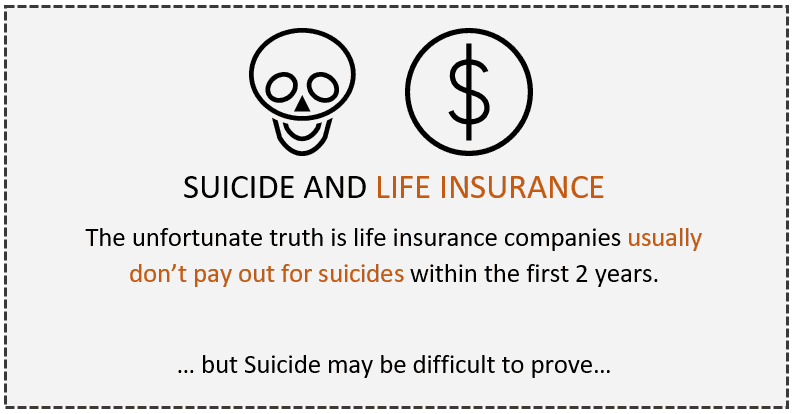
Most life insurance policies also have two year suicide clauses in them, which say the carrier doesn’t pay the death claim if you commit suicide within the first two years. In such a case, their liability is usually limited to a refund of premiums.
AFTER TWO YEARS, the policy is said to be “incontestable“. You can die any way want (including suicide), and the insurance carrier still has to pay out. I read about a case recently where a person with HIV successfully purchased a life insurance policy.
He was able to do so by lying on the application about his condition, and having a friend show up for the medical exam, giving blood and urine in his place. When he died four years later, even though he had committed fraud, the insurance carrier had to pay out.
As you can see….
Suicide is hard to prove, and will usually pay out after the 2 year period.
If you have a loved one who has died from suicide and the insurance carrier is refusing to pay the death benefit, check with my friends at The Center for Insurance Disputes to see if you have any option to fight for a payout.
Beware of a NEW Two Year Contestability Period
If you let your policy lapse and reinstate it, or in some cases when you make a policy amendment, your two year contestability period might start over again from that date.
Please take this into consideration when you make any life insurance policy changes, or when replacing an old policy for a new one.
And again, if you’ve had a life insurance payout declined for any reason, even if the policy was less than 2 years old, there may be hope.
Enter your ZIP code below to view companies that have cheap insurance rates.
Secured with SHA-256 Encryption
Kristen Gryglik
Licensed Insurance Agent
Kristen is a licensed insurance agent working in the greater Boston area. She has over 20 years of experience counseling individuals and businesses on which insurance policies best fit their needs and budgets. She knows everyone has their own unique needs and circumstances, and she is passionate about counseling others on which policy is right for them. Licensed in Massachusetts, New Hampshire,...
Licensed Insurance Agent
Editorial Guidelines: We are a free online resource for anyone interested in learning more about insurance. Our goal is to be an objective, third-party resource for everything insurance related. We update our site regularly, and all content is reviewed by insurance experts.